Borinken, a “Floating island of garbage”

By Carlos Calo Rodríguez / Thursday, November 7, 2024
Puerto Rico: it is an island with roughly 3 million people and is 100 miles long by 35 miles wide.
To put it into perspective, 30 states have a higher population than Puerto Rico, and the island is
smaller than every state except Delaware and Rhode Island. But let me tell you how special it is;
you may know who Roberto Clemente, Felix “Tito” Trinidad, Iván Rodríguez, and Roberto Alomar are, or more presently, you may know Alex Cora, Yadier Molina, Francisco Lindor, Carlos Arroyo, Miguel Cotto, Monica Puig or Jasmine Camacho Quinn. What do they have in common? They are all Puerto Rican worldwide athletes, and those are just some of them.
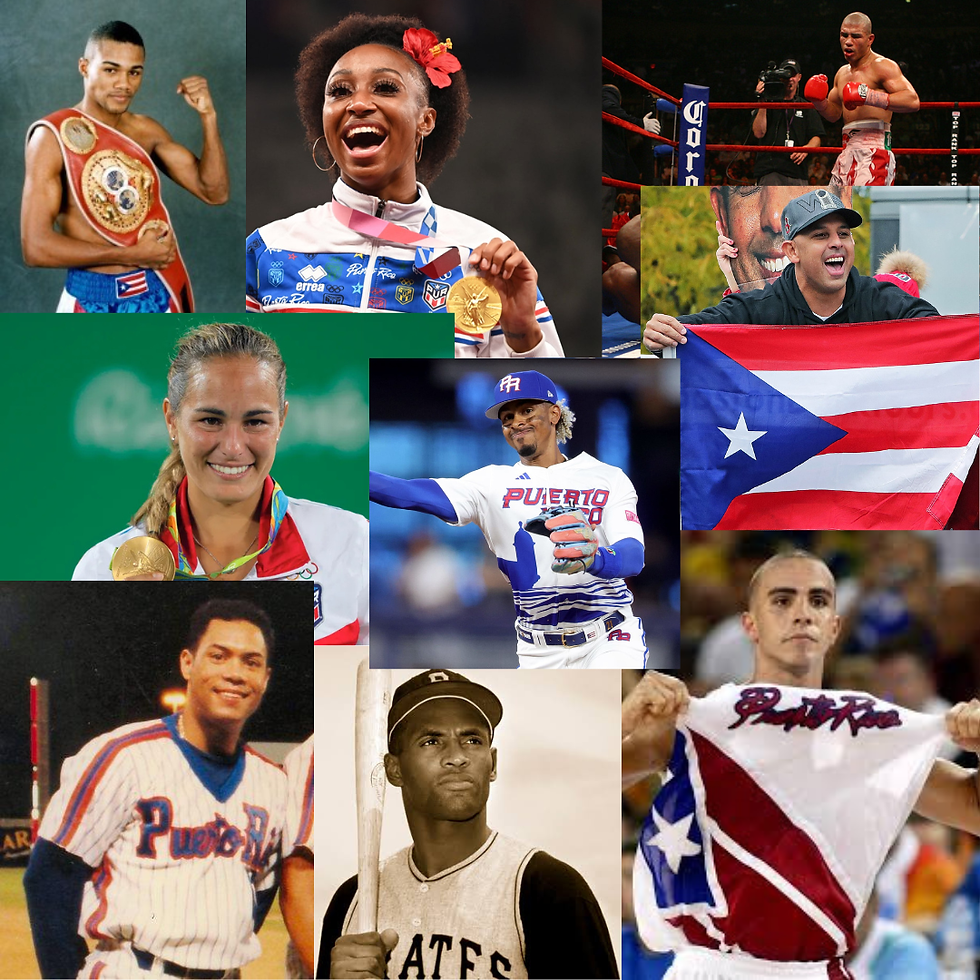
Why is this important? Because history is. A kid who was born in San Juan, Puerto Rico, on March 13, 2000, has a story to tell. He started in sports at just three years old, when he picked up his first bat. That’s right, baseball. If you were born on the island, either you or someone in your family plays the sport. His idol? He didn’t have just one; every athlete who put on the Puerto

Baseball was a thing of just six years for him. His brother Efrain started playing, too, because if his brother was playing, then he wanted to try it, too. But Efrain didn’t like it that much, so after just one practice and one fly ball into his face, he decided that it was not for him. Their parents
decided that the environment in the parks was too hostile for a kid that age, so the baseball dream didn’t exist anymore. Efrain’s brother wanted to keep playing sports, so he decided to start on some volleyball clinics at his school, Academia Santa Rosa de Lima, in Bayamon. There, he developed great skills, and his first competitive experience was playing with elementary school kids in 5 th and 6 th grade. The only thing was that he was in 3 rd grade and could walk under the net without bending down.
That didn’t stop him, though, just like it didn’t stop any Puerto Rican athlete looking to make it out of the island and play professionally to represent the island. He kept playing volleyball, and the coach at his school invited him to play for a club, Vaqueros de Bayamon, the Cowboys.

There began his love for volleyball, a sport that he keeps playing to this day, 17 years later. He played for his school and club, being one of the best in his position at his age while being the shortest, too. His dream of representing his island came true in 2012, when he made the 1st
team of his club and flew to Dallas, Texas, to play in a National Tournament. It was one of the best experiences of his life; he and his club won that tournament without dropping a set and even got the opportunity to watch France, Italy, and the United States Men’s National Volleyball teams. After that year, they told him at the club that he was too short to keep playing the sport. He got kicked off the team and only played at his school. Looking for something to do, there was golf, a sport that his dad played for eight years in amateur tournaments, winning 10 in Puerto Rico. He thought that maybe this was his way into representing Puerto Rico as an athlete; he took classes and was getting pretty good at it but never competed.
He just jumped to another sport, the world’s sport. In the United States, they call it soccer, but in the rest of the world, it is called football. And there he was, playing football for his hometown club, hoping this was the right sport for him and his dream of representing his island. He played for 10 years, from 2012 to 2022. He never got the chance to represent his country, but he got something better out of it. After Hurricane Maria hit the island, there was no time to be thinking about sports, so he forgot about them and focused on what he thought was going to be his future. The family pressure got to him, and he decided to study biology and pursue a career in medicine after that. He loved sports, and with medicine, he could still be near athletes. But something was not clicking for him; he decided to drop out of his biology degree and get into another university to pursue a degree in journalism. In journalism? That was the question everyone in his family was asking him at every reunion. He also heard comments like, “There is no future in that career” and “There are no opportunities on the island for that,” but he ignored all of that and went for it. He got a scholarship to play football at his new college and didn’t think twice about it. In his first year as a dolphin for the Universidad del Sagrado Corazon (Sacred Heart University) in San Juan, Puerto Rico, he started all games that season as a defensive midfielder. You saw that right, a 5’6” and 130 pounds defensive midfielder. Modern football defensive midfielders like Casemiro or Sergio Busquets are at least 6’0”, but there he was, starting every game of his first college season, and to prove everyone wrong, they lifted the national trophy after 26 years.
He thought that was it for him, but he got a second year. The team named him captain, and even though they got eliminated in the semifinals that year, it was a great one. After that, he graduated with a bachelor’s degree in journalism and a minor in photography. That was the end of football for him, but did he ever get his chance to represent his country? The answer is yes.
This story is about me, and yes, even though I never got the chance to represent my island on a national team, I represent them with every step I take. After getting my bachelor’s degree, I started working as a photographer and a communications teacher in my high school. That way, I was representing my island, helping young students to make their own decisions and to always give their all in everything they do. That’s also how I ended up here at Quinnipiac. I never got the chance to experience studying outside of Puerto Rico; my English wasn’t the best, and it was going to be my first time living alone in my 23 years of life at that time. But I took the chance, and it was the best decision I have made in my life. I have all those Puerto Rican athletes in my heart, and even though I don’t play anymore competitively, I have something in common with them. Everywhere I go, I carry Puerto Rico with me. I plan to carry the legacy of Puerto Ricans in sports, in my case, as a sports journalist, but with the same honor of carrying our flag everywhere I go.
Thank you, Tony Hinchcliffe, for saying at Trump’s rally at Madison Square Garden that my country, Borinken (the indigenous name for the island), was a “floating island of garbage” on national television. That made me realize that we are even greater, and the possibilities for us are immense.


Comments